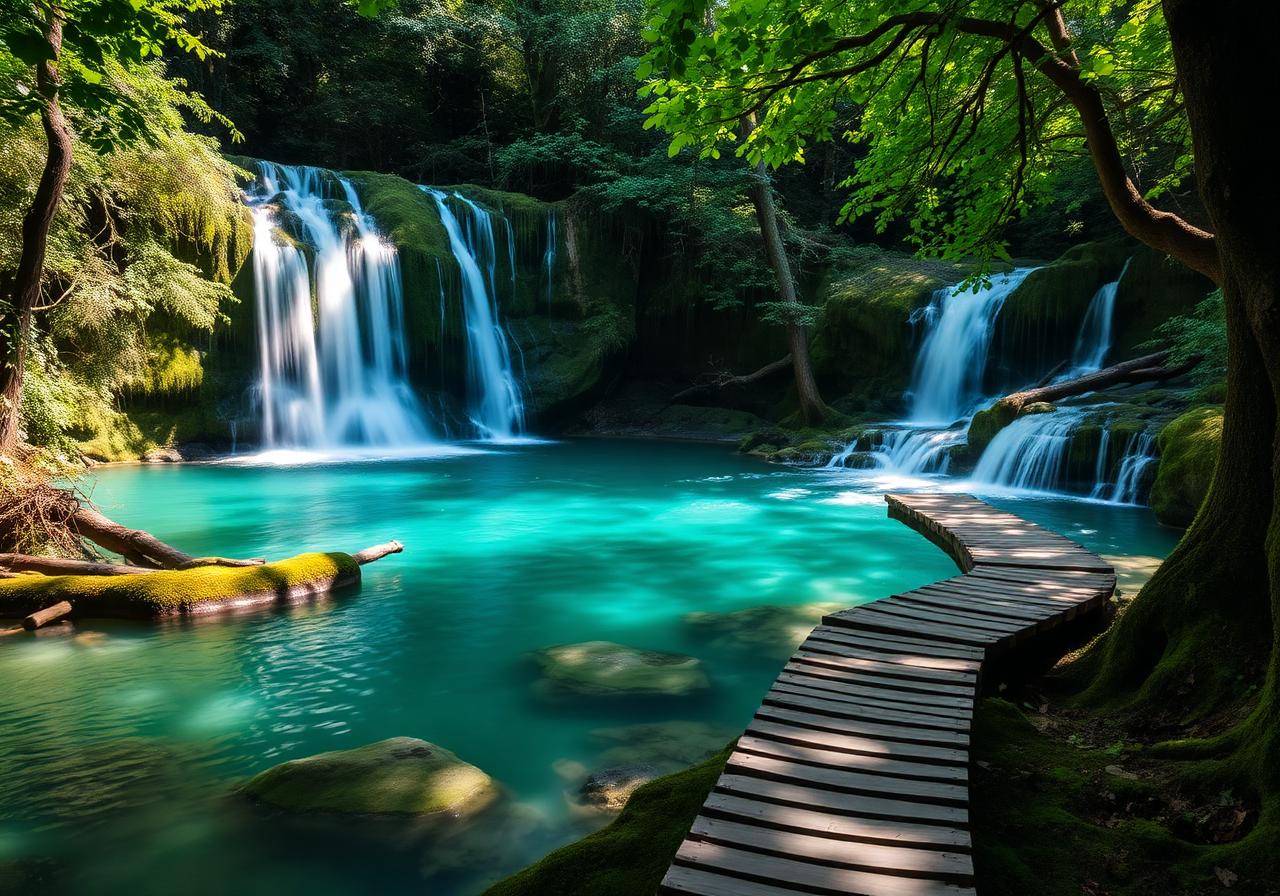
Plitvice Lakes National Park is sixteen terraced lakes connected by 92 waterfalls, wrapped in 295 square kilometres of beech and fir forest, drained by a single river, the Korana, that, over thousands of years, has turned itself into a staircase by depositing tufa, a porous limestone that hardens as the water flows over it. It is the largest and oldest national park in Croatia (1949), a UNESCO World Heritage Site since 1979, and on most summer days the busiest single attraction in the country.
It is also visited by 1.5 million people a year, the vast majority of whom arrive between 11:00 and 14:00 on a coach from Zagreb, Zadar or Split, walk the same 90-minute section of the Lower Lakes in lockstep with everyone else, and leave wondering what all the fuss was about. This is the guide to not being one of them.
Rule One: Sleep Near the Park
The single most important decision is where you sleep the night before. If you drive in from Zagreb or Zadar on the morning of your visit, you cannot arrive before 10:00, and 10:00 is exactly when the day-trip coaches start spilling out at Entrance 1. Sleep in one of the village guesthouses 5, 15 minutes from the gates, Mukinje, Jezerce, Plitvica Selo or Korana, where a double room with breakfast and a home-distilled rakija on arrival runs €60, €110. Hotel Jezero (€140, €220, inside the park, dated but functional) is the only option that lets you walk to the gate.
Rule Two: Book a Timed Ticket Online 48 Hours Ahead
Since 2019, Plitvice has used timed entry tickets to cap numbers. In July and August the 7:00 and 8:00 slots sell out a week ahead; in shoulder season you can usually book the day before. Buy at np-plitvicka-jezera.hr, choose Entrance 2 for the route described below, and screenshot the QR code in case the gate Wi-Fi is down.
Rule Three: Enter at Entrance 2, at 7:00 Sharp
Both park entrances open at 7:00 in summer (8:00 in shoulder, 9:00 in winter). Entrance 2 is quieter, closer to the Upper Lakes, and connects directly to the first electric boat across Lake Kozjak. Be at the turnstile with your QR ready, walk briskly down the wooden boardwalk, and board the 7:30 boat. For the next two hours, you will share the most photographed lakes in Europe with maybe forty other people.
The Route: Programme H, Reversed
The park publishes seven marked routes labelled A to K. Route H is the classic full-day loop, designed to run from Entrance 1 (Lower Lakes) up to the Upper Lakes and back. Do it in reverse, starting at Entrance 2.
Step one: from Entrance 2, walk five minutes down to dock P3 and take the electric boat across Lake Kozjak to dock P2 (15 minutes). Step two: walk the Upper Lakes loop, Gradinsko, Galovac, Okrugljak, Ciginovac and the others, on flat wooden boardwalks that float a few centimetres above water that is, depending on the light, turquoise, jade, or the colour of a 1950s swimming pool. About two hours, four kilometres, almost no elevation, and roughly 60 of the park's 92 waterfalls.
Step three: at ST3, board the free panoramic train back over the ridge to ST2 (10 minutes). Step four: re-board the electric boat from P2 back across Kozjak to P1 (15 minutes). Step five: walk the Lower Lakes path down through Milanovac, Gavanovac and Kaluđerovac to Veliki Slap, the 78-metre Great Waterfall, the tallest in Croatia, finishing at Entrance 1 (about two hours, mostly gentle descent on boardwalks and a final set of stone steps with an iron handrail).
Step six: catch the shuttle bus from Entrance 1 back to Entrance 2 (free, included in the ticket, every 30 minutes until 19:00). Total: 5, 6 hours of moving, 11, 12 km on foot, all but the final climb either flat or downhill.
By 11:00 the tour buses arrive at Entrance 1 and start the Lower Lakes loop. You are already on the quiet side of Kozjak, eating an apple in the shade, watching brown trout the length of your forearm hold their position against the current.
The Photographs Everyone Wants, and Where to Take Them
Veliki Slap from below: the boardwalk junction directly at the base, looking up. Best light: morning, when the falls are in shadow and the limestone behind them glows.
The 'classic' Plitvice shot of layered turquoise lakes seen from above: the viewpoint signposted Vidikovac, a 10-minute uphill walk from the Lower Lakes boardwalk. Most visitors miss it. Best light: midday, when the lakes are fully illuminated.
The footbridge over Galovac: any time. The water on either side is two different blues and the bridge is empty for about three minutes between trains.
Practical Notes
Bring proper shoes, the boardwalks are wet, often slippery, and have no guardrails. Bring water and a packed lunch; the food inside the park is mediocre and overpriced. No swimming, no drones, no leaving the marked paths, no dogs off the leash. The park is open year-round; winter (frozen falls, snow on the boardwalks) is staggering but requires microspikes and a respect for ice.
Getting there: 130 km south of Zagreb, 130 km north-east of Zadar, 270 km north of Split, all on good motorway followed by a 20-minute mountain road. Closest airport: Zagreb (2 hours). Buses run from Zagreb (Flixbus, 3 hours, €15) and Split (4 hours, €25) and stop at both entrances.
Combine with: Rastoke, a village 30 km north where the same Korana river runs between water-mill houses, or the lesser-known Krka National Park further south, where (unlike Plitvice) you used to be allowed to swim. The swimming was banned in 2021; the waterfalls remain spectacular.