If you have searched for a Dubrovnik itinerary in the last five years, you have probably read the same three sentences: it is crowded, it is expensive, it is overrun by Game of Thrones tours. All three are partly true and entirely misleading. Dubrovnik is not crowded all the time. It is crowded between roughly 10:00 and 16:00 on the days a cruise ship calls, usually two to four ships, three to five days a week in high season. Outside that six-hour window, the city is one of the most walkable, swimmable and quietly beautiful old towns in Europe.
This guide is the itinerary I give friends who message me asking how to do Dubrovnik in 48 hours without hating it. It is built around the cruise schedule (published a year in advance at the Port of Dubrovnik website), the angle of the sun on the limestone, and the hours that the city's restaurants, beaches and viewpoints belong to the people who live here. Use it as a template, not a script.
Before You Arrive: Three Decisions That Change Everything
First, check the cruise calendar. Search 'Port of Dubrovnik cruise schedule' and look at the days you plan to visit. If two ships of 3,000+ passengers are arriving, the Stradun will be a slow river of people from 10:00 to 15:00. Plan your morning walls walk and your afternoon swim accordingly.
Second, choose your neighbourhood. The old town is romantic, walkable and noisy until 2 a.m. in summer. Lapad, a 15-minute bus ride west, is where most locals live, quieter, leafier, with proper supermarkets and a pebble beach at the end of the promenade. Ploče, just east of the walls, gives you sunrise views over Lokrum and the best small-hotel stock in the city. If you sleep lightly, do not stay inside the walls.
Third, buy the Dubrovnik Pass online before you fly. At €35 for 24 hours or €45 for 3 days it includes the City Walls (otherwise €40 standalone), all city museums, and unlimited buses. For a 48-hour trip the 3-day pass pays for itself before lunch on day one.
Day One, City Walls at Dawn, Lokrum at Lunch, Buža at Sunset
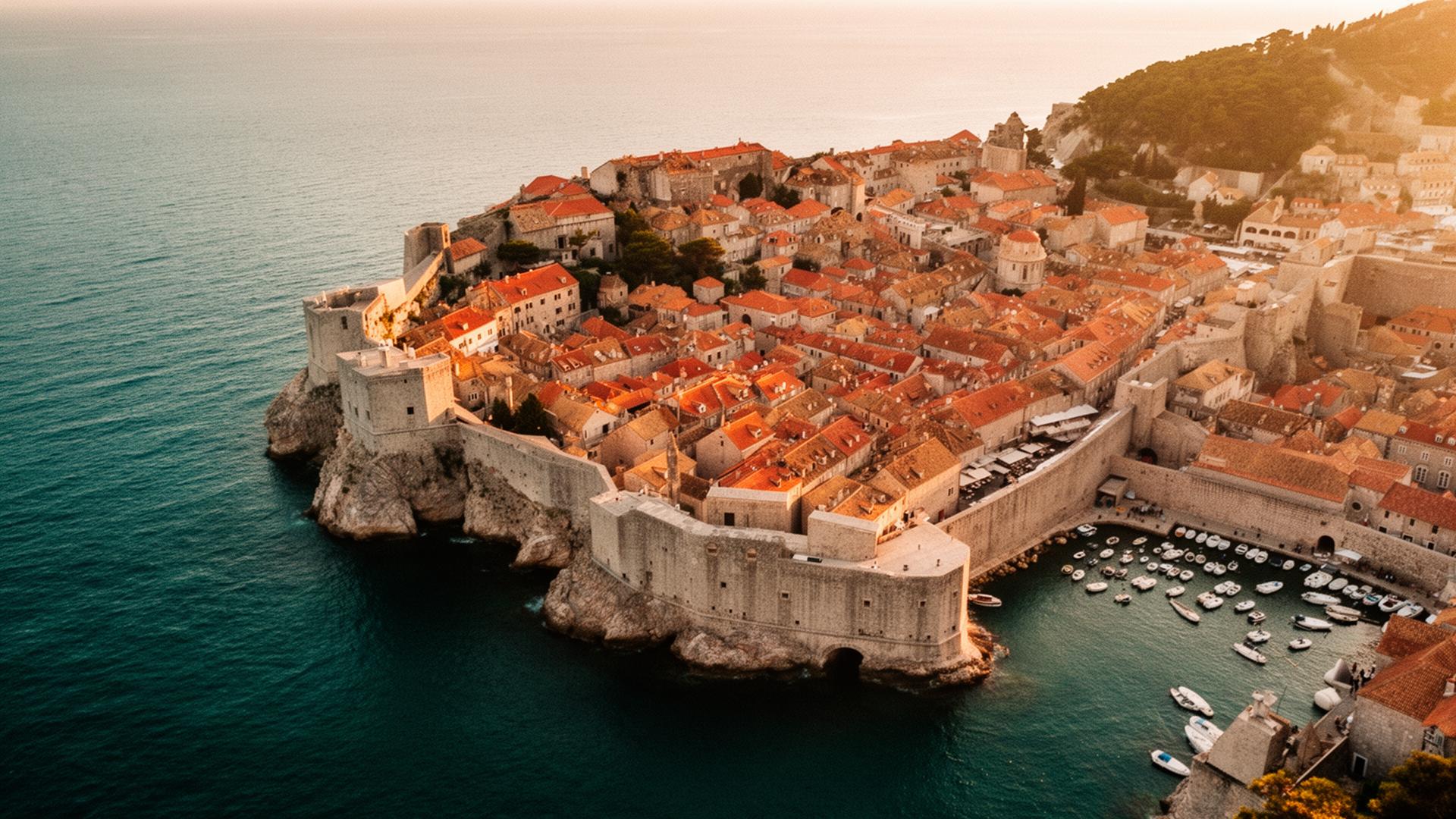
Set your alarm for 6:30. The City Walls open at 8:00 in summer (June, September) and 9:00 in shoulder season. Be at the Pile Gate ticket barrier ten minutes before opening with your pass already scanned to a phone. Walk the full 1,940 metres counter-clockwise, Adriatic on your right, terracotta rooftops on your left, almost no one in front of you for the first hour. Bring a litre of water; the single café halfway around (Caffè Bar Bards, on the Minčeta side) is reliably expensive and reliably out of small change.
By 10:30 you are back at street level and the first tour groups are arriving from the cruise port. This is your cue to leave the walls behind. Walk down Stradun to the Old Port and catch the 11:00 ferry to Lokrum, fifteen minutes across, €27 return, last boat back at 19:00. Lokrum is a forested island with a Benedictine monastery from 1023, a saltwater lake called the Dead Sea (warmer than the open Adriatic, swimmable to anyone with a pulse), a botanical garden of cactuses planted by Maximilian of Habsburg, and a population of opinionated peacocks. The Iron Throne replica from Game of Thrones lives in the monastery cloisters. The cliffs on the south side are the best place in greater Dubrovnik to swim without a crowd.
Pack a lunch before you board. The two cafés on Lokrum are fine but slow. Buy a burek and a bottle of Jana water from the Gundulić market behind the cathedral, or grab a takeaway sandwich at Barba on Boškovićeva for grilled octopus on focaccia.
The cruise ships leave around 17:00. The city exhales. Stradun belongs to children on scooters and old men with newspapers again. That is when Dubrovnik becomes itself.
Return on the 16:30 ferry. Shower, change, and walk to Buža, the cliff-bar accessed through a literal hole in the seaward wall, signposted only by a small wooden sign reading 'cold drinks'. Order a Karlovačko or a glass of Dingač, sit on the limestone shelf, and watch swimmers jump from the rocks twenty metres below. Sunset hits the wall behind you at around 19:30 in July, 18:00 in October.
Dinner: skip the Stradun-facing restaurants entirely. Walk twenty minutes uphill to Bosanka, a hamlet on the slopes of Mount Srđ, and eat at Konoba Dubrava. The peka, meat or octopus baked for three hours under a bell-shaped iron lid covered in glowing coals, must be ordered the day before. The view is the city you just walked, lit up and miniature beneath you. A taxi back to your hotel is €12.
Day Two, Swim, Read, Wander, Climb
Skip the hotel breakfast buffet. Walk to D'vino on Palmotićeva or Stradun Café for a macchiato and a krafna (Croatian doughnut). By 9:00 you should be on the path down to Banje Beach or, better, the unmarked pebble cove below Hotel Excelsior, turn left at the Ploče Gate, follow the seawall east, and look for stone steps cut into the cliff. Swim before the sun is overhead. The water in June is 22°C, in August 26°C, in October still a swimmable 21°C.
Late morning belongs to the museums tourists skip. The Rector's Palace (renaissance courtyard, original 15th-century clock mechanism, blissfully empty before noon) and the Franciscan Monastery pharmacy on Stradun, founded in 1317, one of the oldest still-operating pharmacies in Europe, with original ceramic apothecary jars from the 1400s. Both included in your Dubrovnik Pass.
Lunch: Nishta on Prijeko (vegetarian, six tables, book ahead) or Lady Pi-Pi above the walls for grilled meat with a panoramic view. An afternoon nap is non-negotiable, this is the Mediterranean, and walking the limestone at 2 p.m. in July is a form of self-harm.
At 18:00 take the cable car up Mount Srđ (€27 return, included in the pass). Most visitors ride up, take a photo and ride back down. Do not be most visitors. Walk back down the old serpentine path through the abandoned Napoleonic fortifications, 45 minutes, mostly stairs, mostly empty, sunset on your right the entire way. Dinner at Dalmatino or Lucin Kantun, both small, both excellent, both requiring a reservation 48 hours out in summer.
Practical Notes: Money, Buses, Beaches, Bad Days
Croatia uses the euro since 2023. Credit cards work everywhere; carry €50 cash for taxi-boats, markets and the smallest konobas. Tipping: round up, or 10% in restaurants if service was attentive.
City buses run from Pile Gate to Lapad every 10 minutes, to Cavtat every 30 minutes, to the airport every 30 minutes (€11, 45 minutes). Single tickets €2 from kiosks, €3 from the driver. Do not rent a car, the old town is car-free and parking outside the walls is €5, €8 an hour.
If it rains: the Maritime Museum inside Fort St. John, the War Photo Limited gallery on Antuninska, and the Red History Museum (10 minutes by bus, brutally honest, worth the trip) all reward two unhurried hours.
Best months: late April to early June, and the entire month of September. Avoid June 25 to August 25 if you have any flexibility, the heat, the prices and the crowds all peak together. October is the locals' secret: warm sea, empty walls, harvest food, half the room rates.